Every vendor is a bet. We put a price on it.
You hand each vendor some of your data and some of your business. Vetted shows what that would cost you if it went wrong, next to the most your company has agreed to risk, and exactly what would bring it down.
Every security review has two sides. Vetted handles both.
A score says pass or fail. A price says how far over, and what brings it under.
Here’s how one vendor, Lumen Analytics, goes from a number nobody can act on to a decision you can defend.
Start with the question a score can’t answer.
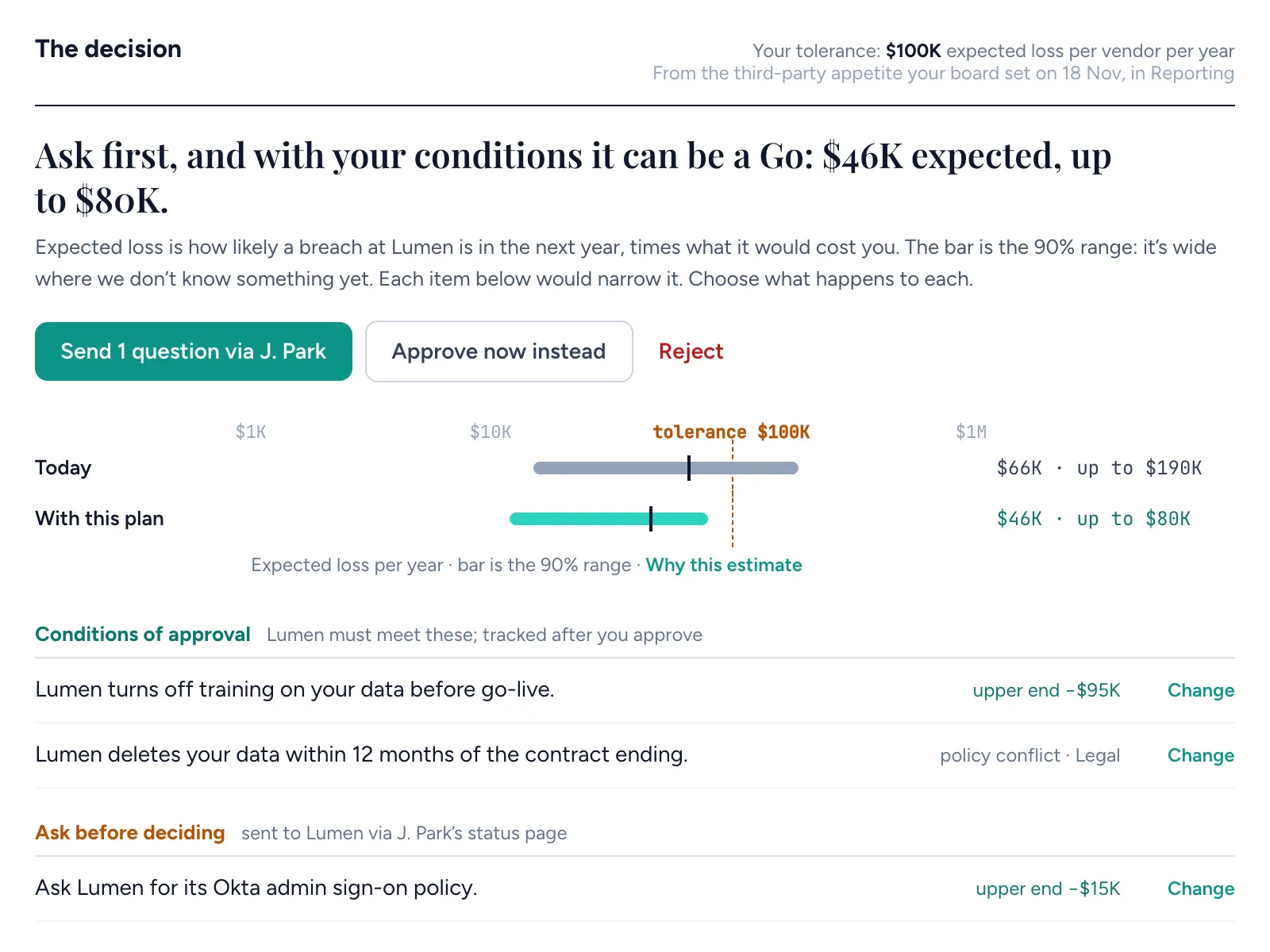
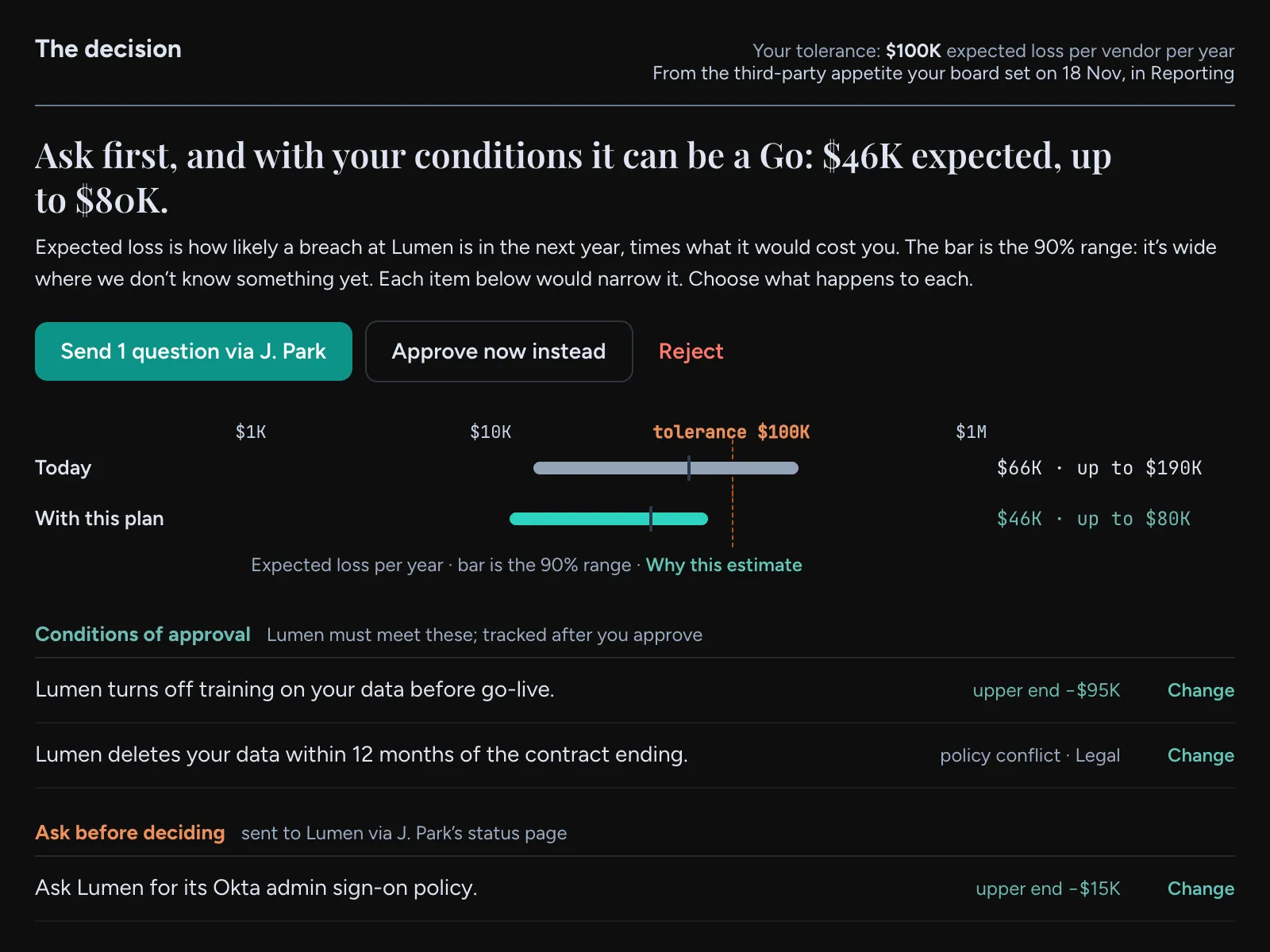
Most vendor-risk tools would give Lumen a 44 out of 100, comfortably under a typical approval threshold. But a 44 doesn’t tell you what signing would cost, or what would bring that down. In dollars, Lumen is $66K a year expected, and at the upper end of its range it’s over the $100K your business has agreed to carry.
Every number shows its work.
Expected loss is how likely a breach at the vendor is this year, adjusted for what’s happening outside it, times what it would cost you given the data and the business you’re handing over. Every input is on the record, stamped with the rule set that produced it, and recomputed when an answer, a signal or your tolerance changes.
Close the gap with your own policy.
Each unknown becomes a lever: make it a condition, ask before deciding, or accept it with your name on it. Conditions come from the clauses in your own policies, so “Conditional” means “meets our policy once these are done,” and each one shows how much it moves the price.
The security review your vendors will thank you for.
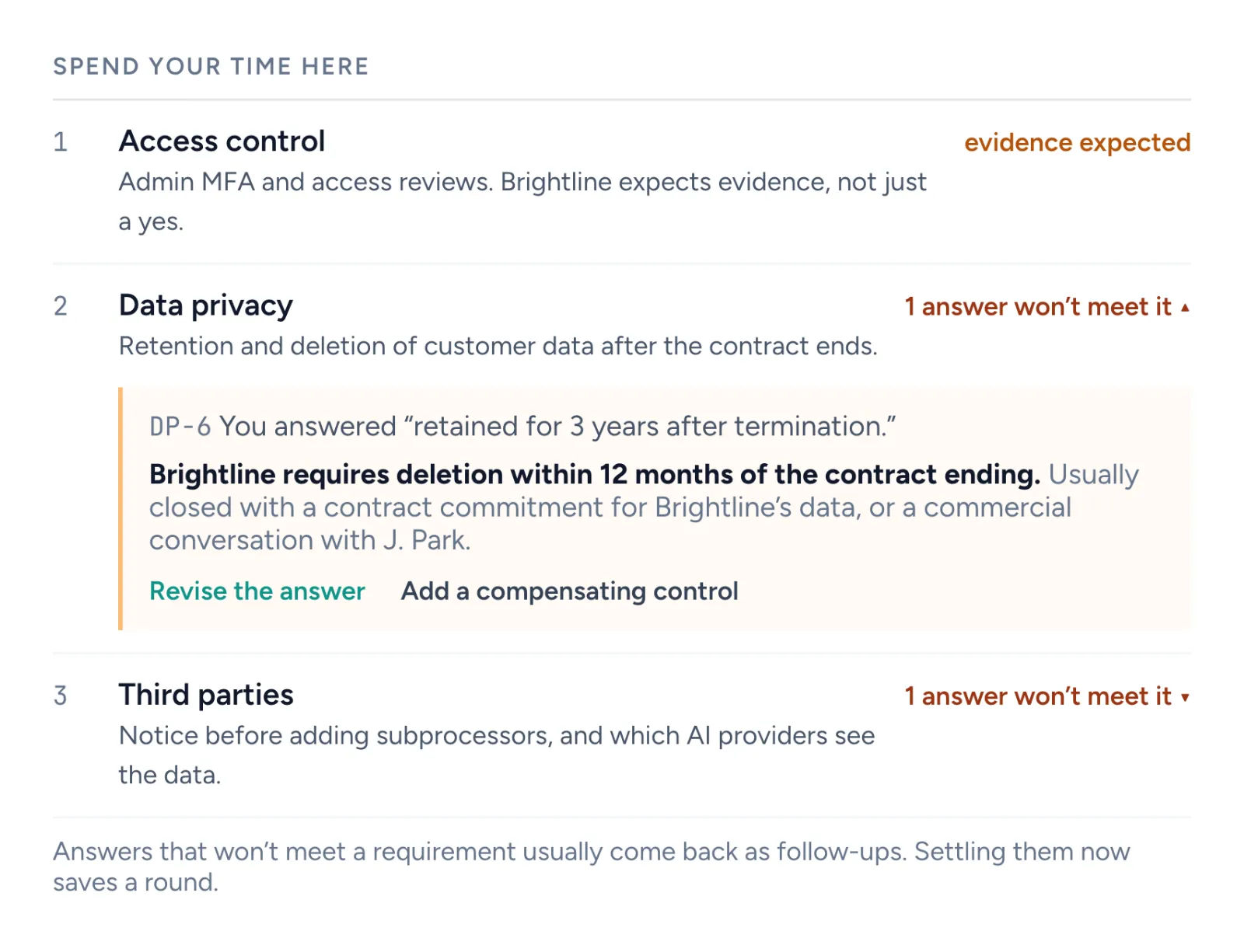
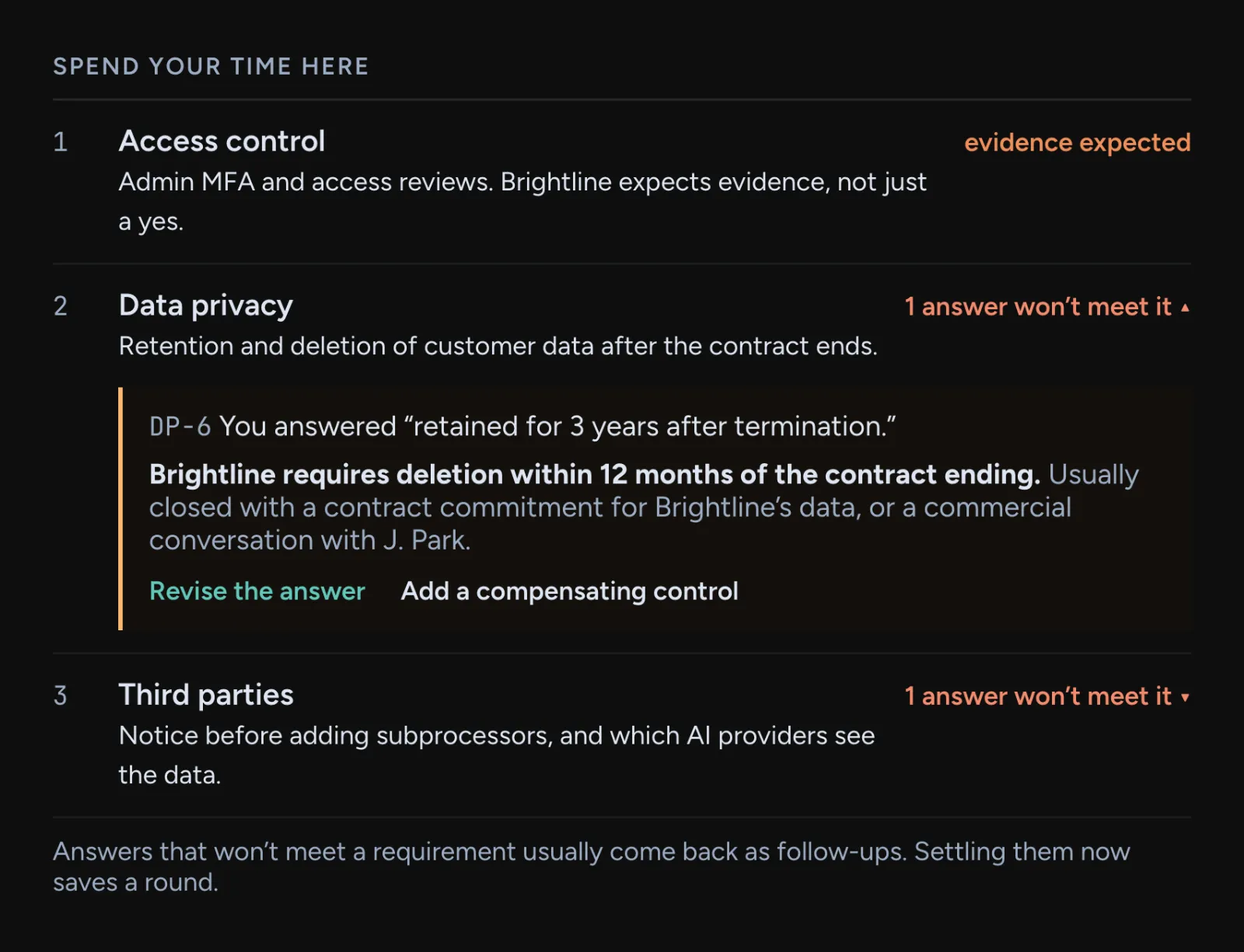
Every answer and document counts everywhere it applies, so 88 questions become 19 to write. Before they hit submit, vendors see exactly which answers won’t clear your bar and where their time is best spent. No follow-up round, no guessing what you meant, and a decision sooner.
For you, it’s a review that comes back complete, each answer next to its evidence, instead of a thread you chase for two weeks.
Know which AI touches your data, and what it would cost you.
Every vendor already tells the world how it uses AI, scattered across sub-processor pages, DPAs, trust centers and AI policies. The register reads all of it, pulls out each vendor’s AI posture with the source behind every field, and gives your team a record to confirm in minutes instead of a research project. Then it does what nobody else does: it prices that posture into the vendor’s expected loss.
Read the launch announcement →Four vendors on paper. One AI provider underneath.
Reviewed one at a time, each of these vendors passes. But all four send your data to the same AI provider. If that provider is breached, or starts training on what it receives, it hits all four at once, and the combined loss is over what your business will accept from a single event.
The register finds the shared provider from each vendor’s own disclosures, and Vetted prices them together. You see it before you sign the fifth, while you can still choose another vendor or make a condition of it.
Signing is the start. Your vendors never stop being watched.
Every vendor you add is watched by eight detection sources. A match becomes a signal to triage, and an incident is estimated the same way a vendor is: in probability and dollars, against your tolerance.
- Eight sources, on from day one: NVD, CISA KEV, GitHub advisories, breach registries, vendor status pages and news. Signals are scored for relevance to each vendor.
- Your notification clock, made plain. GDPR Art. 33 and NYDFS 500.17 clocks start when you determine your data was affected. Until then, the record says so.
- Materiality against your board’s thresholds, read from Reporting, with the decision recorded.
- Decision history and who needs to act. What was decided last time and whether its steps were delivered. Owners from the vendor register, notified in one click.
The vendor you approve changes what you tell your customers.
Most tools do one side. Here, approving Lumen as a subprocessor updates the claim your Trust Center makes about who handles customer data, and tells the customers who rely on it.
“Customer data is processed only by these subprocessors: AWS, Okta, Stripe, and Lumen Analytics.”
Security stops being the thing the deal waits on.
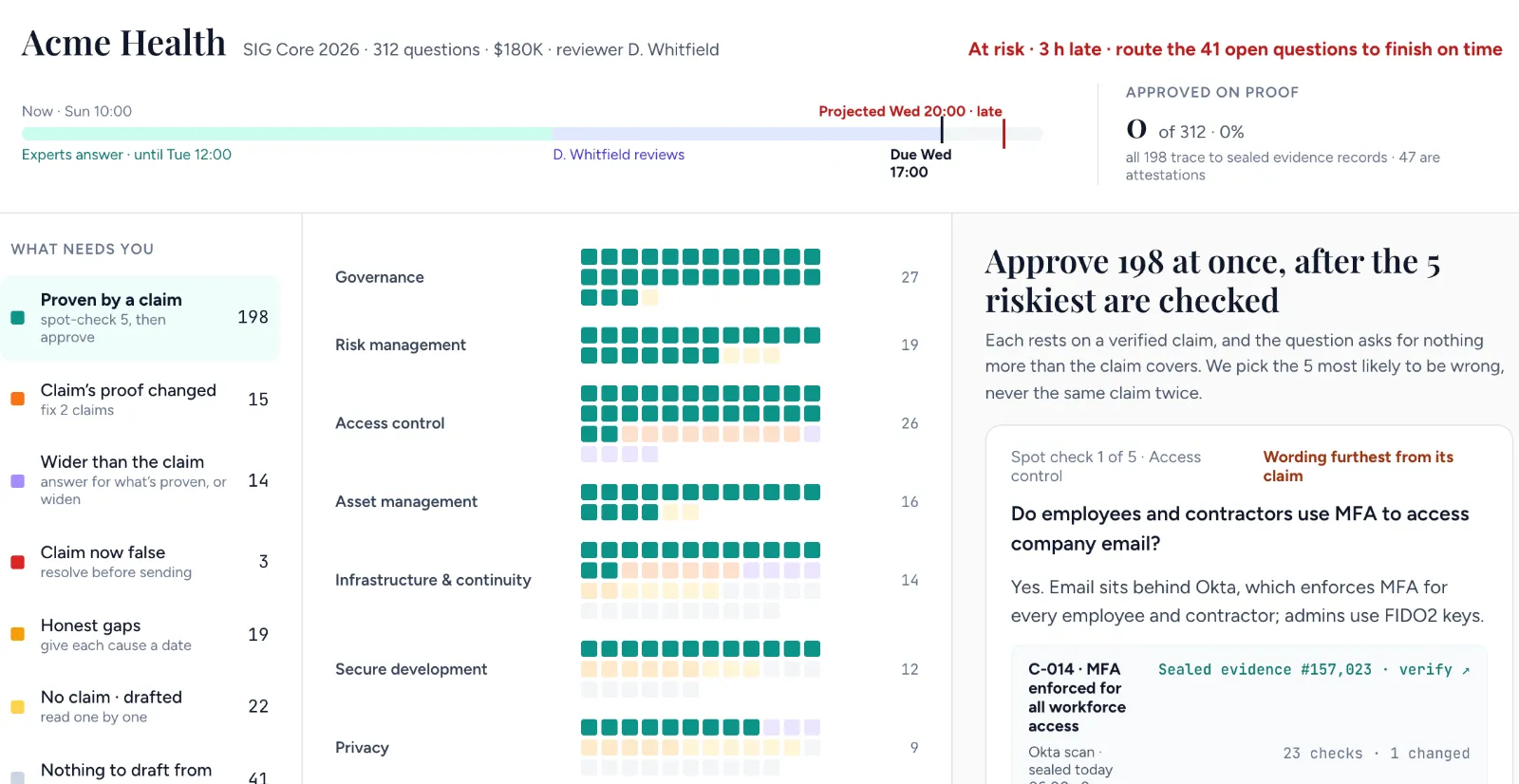
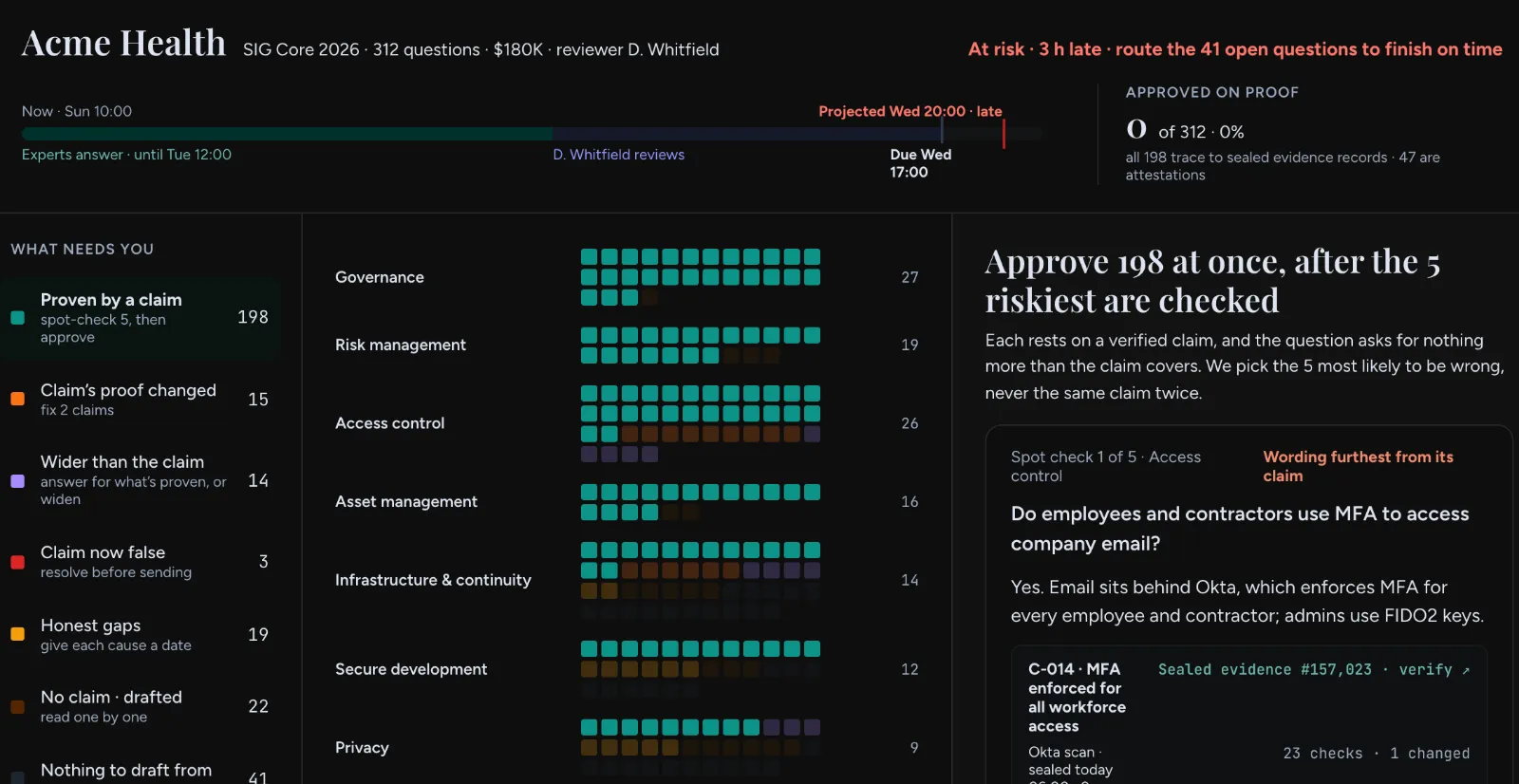
Each approved answer becomes a claim, mapped through the SCF, so one claim answers the same question in SIG, CAIQ, HECVAT, VSAQ or the buyer’s own spreadsheet, with its evidence attached. The library keeps itself current, sales answers on its own when a claim covers the question, and a 312-question review arrives mostly done.
Don’t trust us. Check the math.
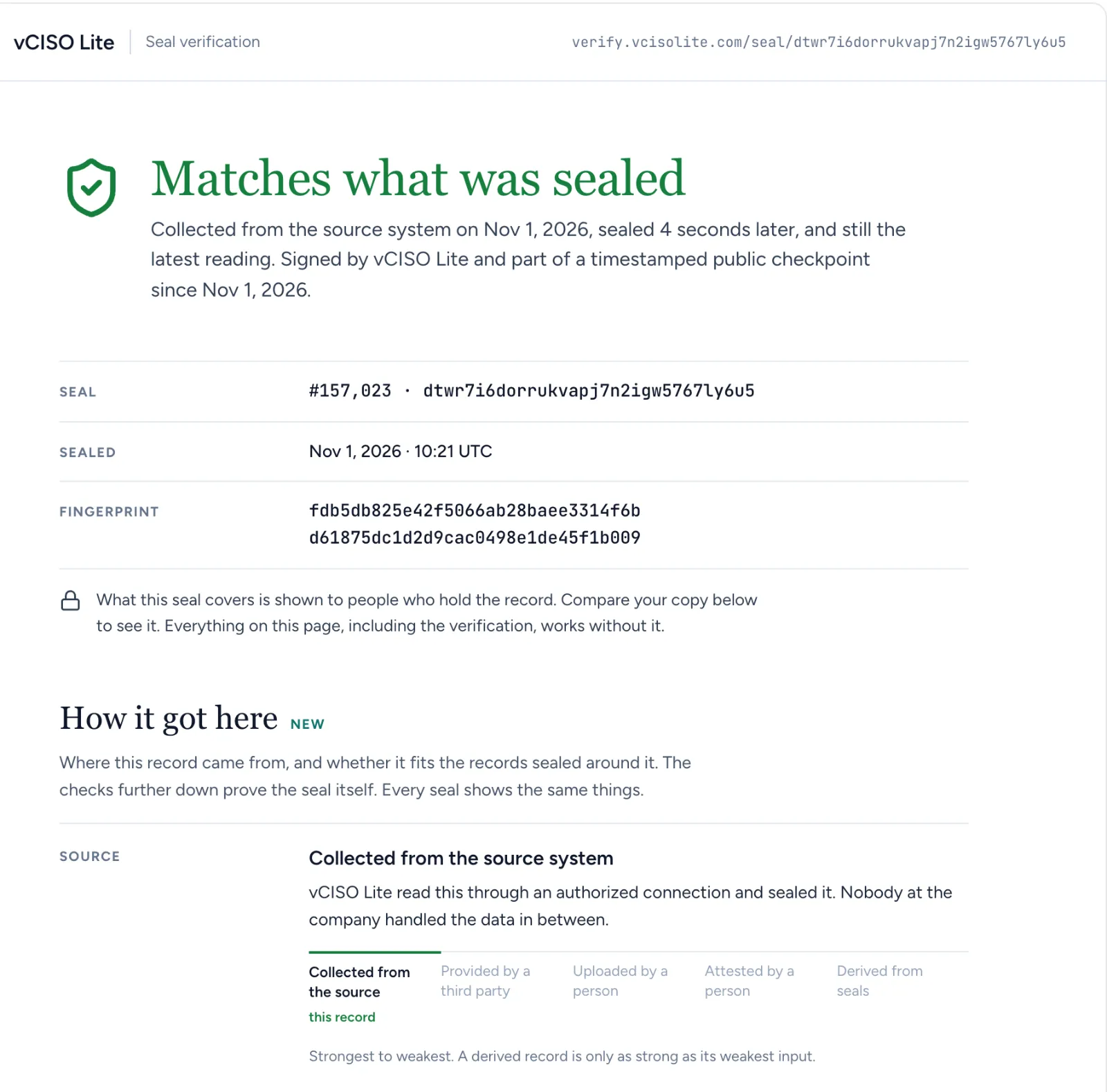
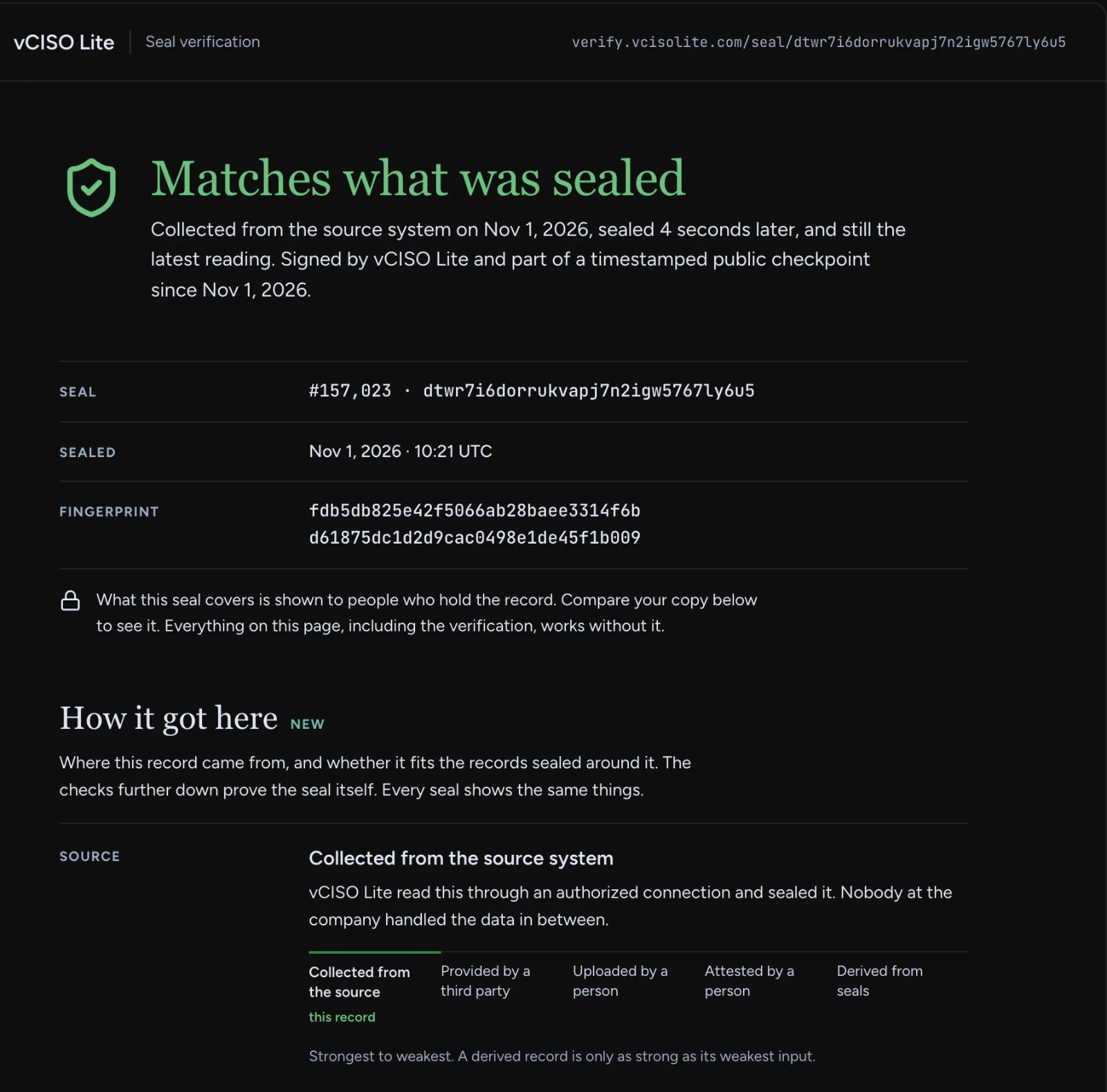
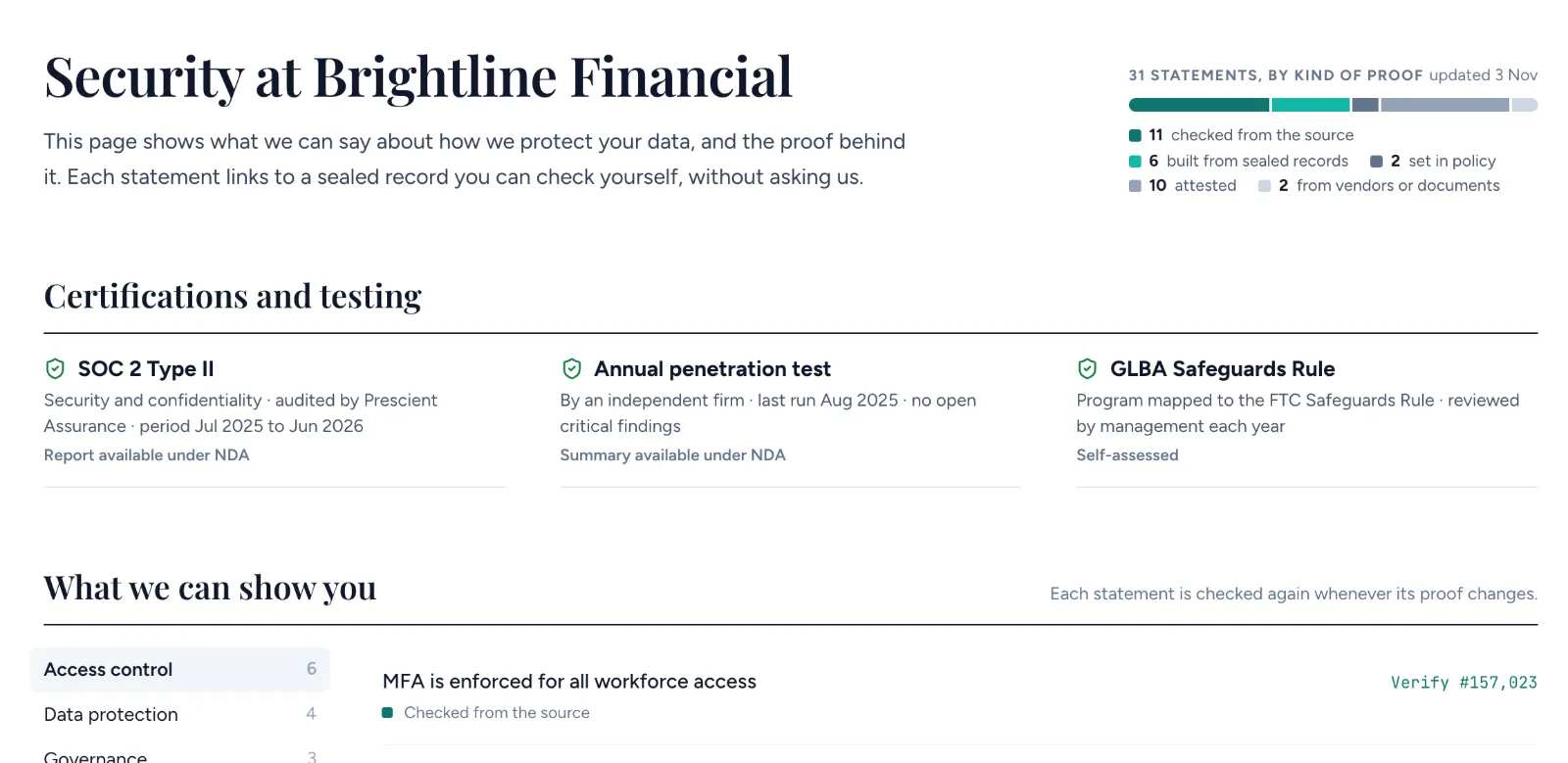
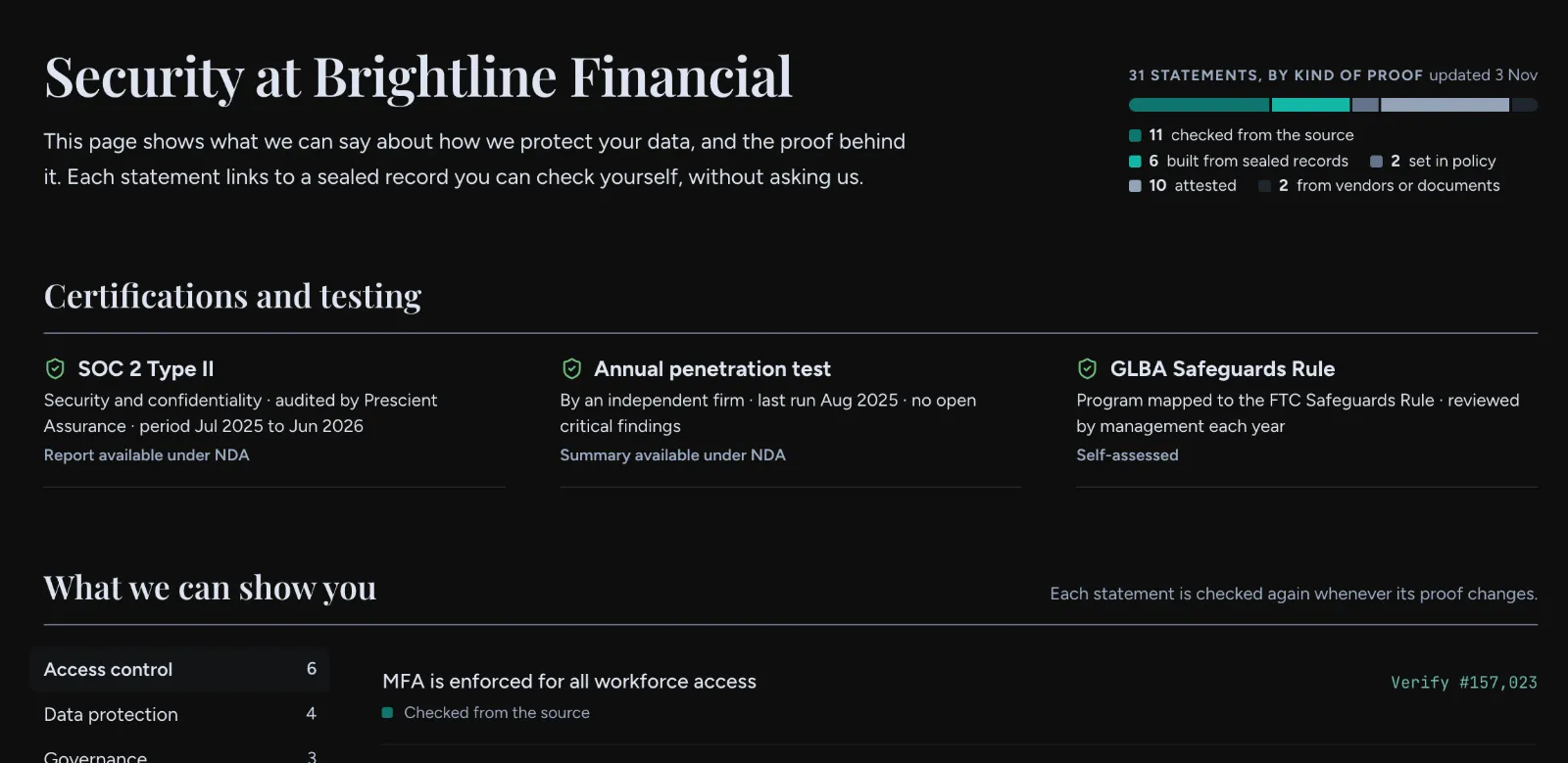
Every claim you make rests on a sealed record. A buyer opens the verify link and sees whether what they hold matches what was sealed, when it was collected, and from where, without asking you or us. They can check it in the browser, or download a receipt and check it offline.
Point your customers to your posture. We keep it current.
A public page for your security and compliance posture, where every statement links to its verify page. Share or revoke documents on demand, with every view logged. Hosted at trust.vcisolite.com on every plan, or on your own domain on Business+.
Every vendor priced. Every claim checkable.
Expected loss in dollars against what your business has agreed to carry, with the conditions that bring it under and the reasons on the record.
Incidents at the vendor, conditions coming due and renewals re-price it, and an approval updates the claims your customers rely on.
Questionnaires answered from claims you can prove, and a Trust Center where every statement opens the record behind it.
COMMON QUESTIONS
The questions buyers actually ask
Why expected loss instead of a 0–100 score?
A score tells you whether a vendor looks better or worse than another. It can’t tell you what the vendor would cost you, because it ignores what you’re handing them. Expected loss is how likely a breach at the vendor is in the next year, times what it would cost your company given the data and the business that depend on it, shown with its 90% range next to the tolerance your company set. The residual score is still calculated during the transition and shown beside it.
How is this different from Bitsight or SecurityScorecard?
Ratings services score a vendor from the outside, the same way for every customer. We use outside signals too, as visible multipliers, but the estimate starts from what this vendor means to you: the data, the access, the business that depends on it, and the vendor’s own answers and evidence. Two companies using the same vendor can get different numbers, and should.
Do vendors need an account?
No. Vendors sign in from a magic link with TOTP, and coworkers request vendors through your SSO. Neither needs a vCISO Lite seat.
Which questionnaires does the vendor portal support?
SIG, SIG Lite, CAIQ and custom questionnaires. Questions mapped to the SCF crosswalk are linked so the vendor answers each one once. Custom questions without a mapping are answered individually.
What happens to the vendors and assessments we already have?
Everything carries over: vendors, assessments, answers, files, contracts and AI posture. Old assessment links redirect to the vendor’s new record.
What if our board hasn’t set a tolerance?
Until a third-party appetite is set in Reporting, the tolerance is derived from your business context, and the record says so.
What’s on which plan?
Vetted is on every plan, including the request link, the vendor portal, the AI Sub-Processor Register and the Trust Center. Incident monitoring with live outside signals is on Enterprise; other plans check signals at request, review and renewal.
Know what each vendor costs you before you sign.
Vet your vendors and get vetted by your customers, on the same evidence. Vetted is on every plan; incident monitoring is on Enterprise.